
Mukhethwa, an independent artist who grew up in the informal settlement of Itsoseng Eskom and later moved to Cosmo City, has a unique perspective on township life. His experiences have deeply influenced his artistic vision, and his work seeks to shift the narrative around townships, highlighting their beauty, talent, and vibrant communities, contrary to the often crime-filled portrayal. Despite not having formal art education in high school, Mukhethwa pursued his passion by studying art and design in college. His art captures the essence of township life, focusing on the daily struggles and triumphs, and celebrating the rich culture and spirit of these communities.
Mukhethwa’s style blends the use of shapes, patterns, and colors to convey deep emotions. His paintings are vibrant and immediately captivating, drawing the viewer’s attention in a crowded room, much like love at first sight. His use of bright colors and abstract forms creates a unique and innovative aesthetic that is both eye-catching and thought-provoking.
I had the opportunity to review the artist’s work and was particularly struck by two of his paintings.
Basetsana
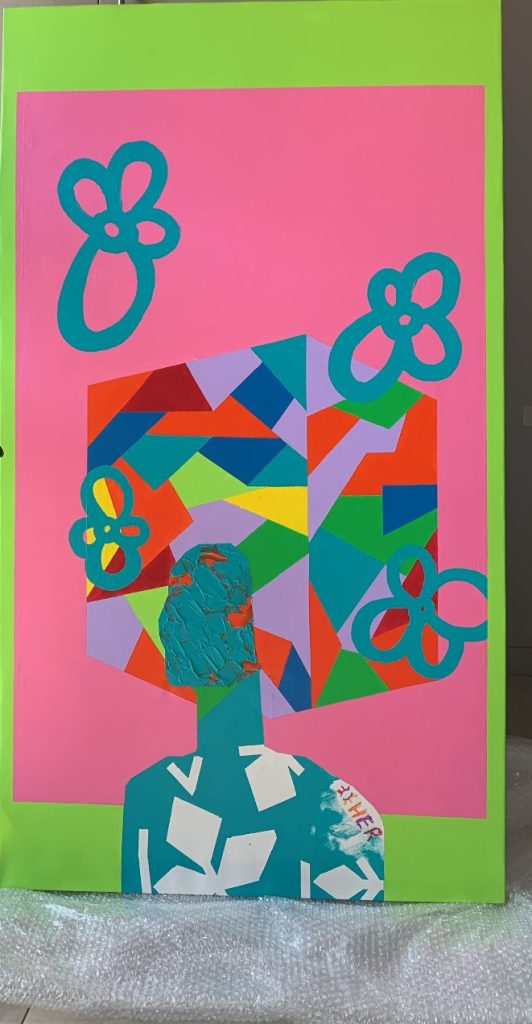
The first painting, titled “Basetsana,” depicts a woman adorned with patches of shapes on her chest and shoulders, different shades and forms in her hair, and ignited orange patches on her face. This piece evokes the image of a vibrant, Afrocentric woman. The white patches on her chest and shoulders symbolize purity, while the vibrant colors in her hair highlight the beauty and strength derived from her experiences. The orange patches on her face seem to be ignited from her hair, signifying the inner vibrance and resilience within her. Her head held high, she exudes strength and beauty through Mukhethwa’s masterful use of color and abstract forms. The intricate shapes and patterns are perfectly put together, demonstrating the artist’s meticulous attention to detail.
Amapantsula
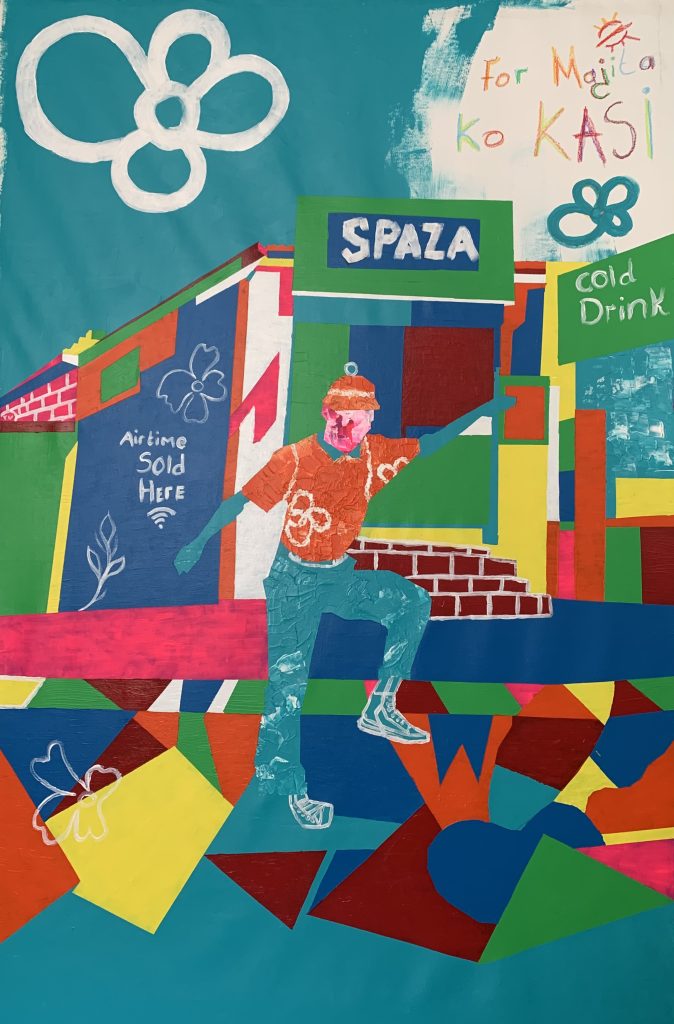
The second painting, titled “Amapantsula”. This piece encapsulates the reality of township life with remarkable detail, featuring a spaza shop—a staple in many townships—symbolizing community and daily life. The abstract elements are evident in the shapes and colors at the bottom of the painting, and the faceless man, adorned in clothing representing “Kasi Kulture,” emphasizes the universality of townships. The vibrant colors in this painting are arresting, capturing the essence of township life and drawing the viewer into its narrative. The artist’s use of shapes is immaculate, with each element perfectly placed to create a cohesive and compelling image. The painting includes flower-like drawings, possibly Mukhethwa’s signature, adding a unique touch to his work.
Mukhethwa’s paintings illustrate that environments often perceived in black and white are, in reality, as lively and renewing as spring after winter. His art is a celebration of township life, offering a fresh perspective that is both eye-opening and heartwarming. His work challenges the stereotype of townships as dull and poverty-stricken, instead presenting them as vibrant, resilient communities full of life and potential. Mukhethwa’s art is deeply inspired by his surroundings, blending abstract art with realistic emotions to tell colorful stories. His art not only captures the struggles and triumphs of daily existence but also celebrates the culture and daily life of the townships.